 6:17
The structure of Dance music in Lego , video 2.
Contents of the video
0:00 A lot of people are saying, how do I get work in a nightclub?
Alright folks, Jonathan here. This is video number two and a couple I'm going to be doing on the structure of dance music using Lego. When I did the first video I thought that's it, there you go, I've shown what the basis is and the whole idea of the structure of dance music basically using Charles Lego but then the more I thought about it, the more I thought well there's more to it and hopefully I can just go slightly more in depth so this is video number two. Now as well Which coincides with this particular video. A lot of people are saying, how do I get work in a nightclub? How can I become a better DJ? Well one way is to actually start making and producing your own music. If you think about it, if you do a mix tape, a mix CD, and you sell that on the sly, well you're actually breaking the law. But if you make your own music and you sell a mix of your own music, you're breaking no laws because it's your music, you made it, you produced it,
You could do anything you want with it. So, think about it. If you can make your own stuff, then you're that next step higher to becoming a better DJ because a lot of these big superstar DJs will make their own music. They'll go into a nightclub and they'll play tracks you've never heard before. The reason being is because they made them and they're the only people who've actually got that particular piece of music. Now this is video number two in the structure of dance music Alright folks, for those of you who haven't actually seen video number one, basically what we're looking at here is every single one of these dots is a bar in music and we count a bar as follows. One, two, three, four. One, two, three, four. One, two, three, four. One, two, three, four.
2:09 Melody, vocals, those beats
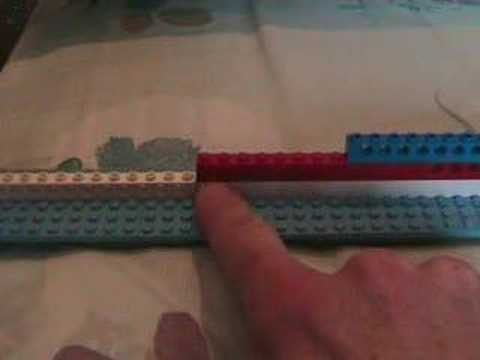
Every four times we count a bar, we call that a phrase, but I personally count it like this. It's up to you how you want to count it. 1, 1, 2, 3, 2, 1, 2, 3, 3, 1, 2, 3, 4, 1, 2, 3. Now let's say for example, in this particular track we're going to make, our actual timing was 120 beats per minute. In other words, every time I counted like this, 1, 2... And though we heard those beats, and those beats were equally stretched apart, equal timing, and we had 120 in a minute, think about it, by actually making this structure, we could work out exactly how long this structure was going to be if we were going to make an entire song using this Lego. Now just very quickly as well, the white Lego is the beat, the red Lego is the actual bass line,
This is the melody and then further along there you'll have black, which is the actual vocals. And it does get a little bit more interesting later on. So let's just pan out a little bit. That's in and that's blurred, that's out. Okay so we've basically got our beat chugging along quite nicely and then we have the bass line come in. Now if we count on here 1 2 3 4 5 6 7 8 we've got eight bars or two phrases of beat And then we have the melody come in, like so, and we've got that melody chugging away quite nicely. And then all of a sudden we have the melody stop. So we're left then just with beat and with bassline. And then as soon as the melody comes back in, bang, we have the vocals. Now the vocals stays in for quite a large amount of time and possibly this thing's going to go all over the place here. And then the vocals goes and we have beat, we have bassline and we have melody.
4:05 1-1-2-3, 2-1-2-3, 3-1-2-3, 4-1-2-3
And it just fits on that platform over there quite nicely. And then about here, now, we have the vocals come in again. But if you look here, at this particular point here, the actual melody starts to just vanish and disappear. Now if you can see there, we have one, two, three bars. But, if you notice, there's a slide there. Now that's the fourth bar, that's the phrase. 1-1-2-3, 2-1-2-3, 3-1-2-3, 4-1-2-3. And it just filters out, slowly slides out. And then also the beat. One, two bars, and then we have two bars there where the beat filters out. Now can you see here something quite interesting? This here is a thin white line. This is an underlying beat. As this beat filters away... This underlying beat starts. Now this could just be, say, the hand clap or just the bass beat or maybe some tiny intricate part of the beat in some part of it, not the entire beat, just a tiny bit. But can you see this structure here? Now this is still the vocals but this is the bridge. Now guess what? The bridge is a part of the music that is still there but it's maybe a slightly different key.
At this point here in the bridge, the beat as it used to be has gone. But at this point here now where we come back off the bridge, you can just see we have the beat starting again, we have the underlying beat there as well, and then when we're back into the actual proper vocals, just after four bars, we have the beat, bassline. And melody start. Now this hopefully gives you a general idea, and I just thought I'd put the dragon in there as well. So of course we're not quite finished. But this gives you a general idea of the structure and what it would look like theoretically if it was 3D. Now bearing in mind you wouldn't have holes in it because I've spent the last hour trying to find this bloody Lego. And there you go. So hopefully that will give you a general idea. So this is video number two. Now hopefully all being well in video number three.
What I'll do, I just broached the subject very briefly in video number one about the actual structure of putting two tracks together and what it would actually look like if we used it in kids Lego. Alright, so thank you to Ryan and practice and enjoy.
This transcript was produced automatically from the audio of the video and may contain mistakes.