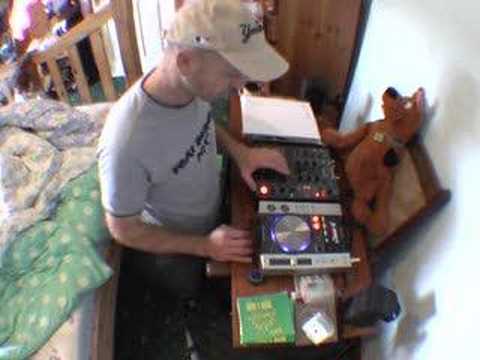
 8:51
Counting the bars and phrases in drum and bass
On YouTube this video is called Tutorial on mixing Drum & Bass, counting the bars, phrases
What this lesson teaches
The lesson that makes drum and bass make sense, and it turns on a single observation.
The labels do not matter
He says you can count a phrase as 1-2-3-4 four times, or as 1-1-2-3, 2-1-2-3, or as bananas, apples, oranges, pears. What matters is the structure of the counting, not the words.
That is worth hearing if you have been treating his notation as a rule. It is a scaffold, and you can use any scaffold that keeps you in the right place.
Fast and slow at the same time
Here is the insight.
Drum and bass is very fast - 170 to 180 BPM. It is also, simultaneously, very slow, because it is half-time music. The snare falls on beats two and four of a bar counted at half the rate, so the feel of the music - the thing your body moves to - is happening at around 85 or 90.
Which means a drum and bass track at 180 and a hip-hop track at 90 are carrying the same underlying pulse. He demonstrates exactly this: count the hip-hop record and you get 90, count the drum and bass record the obvious way and you get 180, and they are the same thing measured twice.
That is why the two genres sit so naturally together, why drum and bass DJs drop hip-hop acapellas over their tracks, and why half-time sections in drum and bass suddenly sound like something else entirely.
Counting without speaking
The practical method, and it solves the problem of the previous lesson.
You cannot say "one two three four" out loud at 180 BPM for three minutes. So do not. Count the bars silently, and put a cross on paper every time you complete a phrase.
Four beats is a bar. Four bars is a phrase. One cross per phrase - and your hand is now moving at a quarter of the speed your mouth would have to.
What you end up with is the same written map as in the structure lessons, produced from music far too fast to narrate.
And the structure is still there
Four phrases make a block, exactly as in house. The music is quicker and the architecture is identical, which is the reassuring thing to discover.
Contents of the video
0:00 A phrase is basically four bars

Alright folks, Jonathan here. In this video we're going to be looking at counting bars and counting phrases in drum and bass. A bar, 1-2-3-4. A phrase is basically four bars. You can count it in many ways. 1-2-3-4, 1-2-3-4, 1-2-3-4, 1-2-3-4 or 1-1-2-3, 2-1-2-3, 3-1-2-3, 4-1-2-3. Or bananas, apples, oranges, pears, bananas. In other words, it doesn't really matter. The main thing is the structure of how you count. Now drum and bass is quite a fast type of music, but there's an irony. It also could be classed as a very slow type of music. For example, let's say we listen to a track that's hip-hop and we count the beats in that particular track. The DJ Tutor is a great tool to help you get the most out of your drum and bass track.
That's 180. The reason being is because it's half speed. So, this is the way you do it. A drum and bass track is as follows. The beats would be 1-2-3-4, 1-2-3-4, whereas the hip hop track would be 1-2-3-4, 1-2-3-4, like so. Right, what we'll do now is I'm going to play this particular track and I'm going to count the bars. And then I'm going to count the phrases, here we go. Right from the very beginning, because this is an actual mixed CD, so this particular track isn't from right at the beginning, it's the area which the actual CD player has taken, all of a sudden it's taken that position where it's going to start from. Luckily it's at the beginning of a bar, so here we go. 1-2-3-4, 1-2-3-4, 1-2-3-4, 1-2-3-4, 1-2-3-4.
2:21 It's very difficult to count that fast
That is fast, isn't it? It's very difficult to count that fast. So, what's the best way of actually counting it? Again, with phrases. Now, what I'm going to do now, I've got my piece of paper here, like so. I've got my pen at the ready. Every time I hear a phrase, I'm going to put a cross on that piece of paper. Now, I don't have to count 1, 2, 3, 4, 1, 2, like so. I can count like this, 1. In other words... One, two, three, four. In my mind, one, two, three, four. One, two, three, four. One, two, three, four. Four bars, one phrase. As soon as I get one phrase, I put a cross on that piece of paper. It'll all make sense in a bit. Here we go. Now then, think about it from a structure point of view. One bar is four beats. One, two, three, four. Four bars is one phrase. Well guess what? We've got four phrases.
4:16 Here, where's the beat?
There. Hopefully it'll start to make sense. This is the whole idea about what I'm trying to get into you guys, and that is simply this, and that is music. 99% of dance music is structured. It's like it starts, it grows, comes back down a bit, it grows, comes back down, and then it finishes, smooths off. It doesn't all of a sudden start and stop all over the place. There's structure to it. Let's have a listen to this particular track. With the volume down. Now here, where's the beat? How on earth can you count there? This is what you would do. Again, if you haven't watched the video I made about 10 minutes ago then you wouldn't understand where I'm coming from here but I suggest you go and watch that one and then it'll all make sense. Now what I would actually do with this particular track, I would listen to...
The actual track first, where there is a beat. And then I would near enough get the sort of timing that I would need. Now at the beginning of this track you've got that airy feel, no beat whatsoever. So using that information I took from the middle of the track, I can get near enough a general idea of the speed, the tempo of the track. In other words then, I'll be able to roughly count the bars. Practice, practice. For God's sake, if you've only been mixing drum and bass or any music for that matter, for let's say one or two weeks, some people it clicks. Other people it takes a long time. That's the beauty about being a human. Sometimes it takes forever, sometimes you can just walk into it and it'll drop and you'll think, wow, that's easy. A lot of people, it's damn hard. So what we'll do now, we'll have a listen to this and we'll try and work out the actual bars and the phrases with no beat.
6:48 It to you but I hope
Here we go. Volume up this time. See, it's a nightmare! Absolute nightmare! Like I said earlier, if you get that mixed to begin with where the beat is, then theoretically there's not necessarily any need to count. You can count the actual bars at the beginning but also once you've got it in beat then what you can actually do is you could start that off where there's no beat, in with this track where there is an actual beat and you can count using the beat of the other track to get the exact timing of the bars where there is no beat. Now again some of you are probably thinking what the hell's he on about but it's all very logical. As follows, here we go. Let's play this one and put the volume up. Now we've got timing there. So, here we go. 1-2-3-4
Alright, absolute nightmare because I've got no headphones on and I'm trying to explain it to you but I hope you get the general idea, alright? You know, all these videos, a lot of them are, what do I say, a bit of fun. Hopefully, even if you watched every single video I made, if you got a tiny bit of information off each one, then hopefully you can bung that all together and hopefully get quite a bit of information. It's all about sharing and I'm having a damn good bit of fun here. I do get shouted at occasionally because I play the music too loud. That's why I've got small diddy speakers here today. But it's another tiny tutorial with regards to mixing drum and bass. For a lot of people watching this, they'll think, I already know it. Some people watch it, they'll think, I didn't know that particular point. And other people, they'll think, well, I didn't know another particular point. But, like I said, if you can get a tiny bit of information somewhere from this video that will help you, then all the better. So, practice and enjoy.
This transcript was produced automatically from the audio of the video and may contain mistakes.