 7:52
Catching a slow track: overshoot, then settle
On YouTube this video is called Dj tutorial, mix lesson 1 for the beginner!!!!!
What this lesson teaches
This is the lesson that explains why beatmatching feels so unintuitive at first, and it does it with two toy cars sitting on a Technics platter.
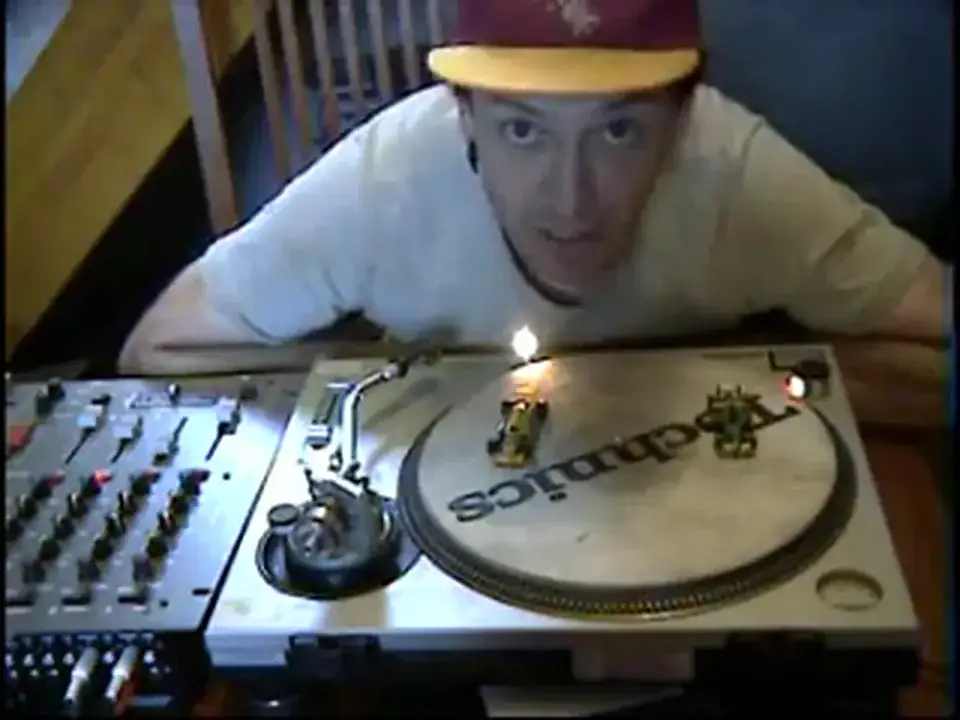
The catching-up problem
Imagine two cars setting off together, one at 138 miles an hour and one at 130. After a few seconds the faster one is simply further down the road, and the gap keeps widening.
Now ask how the slower car catches up. Matching speed is not enough. If it settles at 138 it will hold the gap exactly as it is, forever. To close the distance it has to go faster than 138 for a while, and then come back down to 138 once it has drawn level.
That is the whole problem in one picture. Two tracks at the same tempo but in different places will stay in different places. Getting them together always means a spell of deliberate mismatch, followed by a return.
Why the ear replaces the eye
A driver closing a gap does it by looking sideways until the wheels line up, then easing off. You cannot look at two records and see that. The headphone in one ear does the job the driver's eye does - it is the feedback channel that tells you how far off you still are.
He makes the precision concrete with the stylus. The needle is a single point. For a clean mix, the point on one deck has to strike the beat at the same instant as the point on the other. There is no "close enough" that survives for long.
The move itself
Watch what he actually does with the pitch, because it is not what most beginners do.
He does not nudge the pitch gently towards the right number. He pushes it well past, lets the track visibly gain ground, and then brings it back once the beats are together. The large movement closes the gap; the return sets the tempo.
Beginners tend to do the opposite - tiny adjustments towards the correct speed, which is exactly the move that never closes a gap. The gap only closes while the speeds are different.
Two habits worth stealing
Keep a finger resting on the pitch until you are certain. The moment you take your hand away you have committed, and if the tempo is a fraction out you will not know for another thirty seconds.
When you bring the pitch back from an overshoot, look at where it started and return slightly above or below that point rather than exactly to it. If you needed to speed the track up at all, the resting position is not the one you began with.
What to ignore while you are learning
Set the channel levels once and leave them. Do not touch the EQ. Both are real skills and neither helps here - they add variables to a problem that is already asking you to hear one thing precisely. He is blunt about this: the EQ is for when you are good. For now it is fingers on the pitch and ears on the beat.
Contents of the video
0:01 This is the second lesson, Idiot's Guide, Beginners
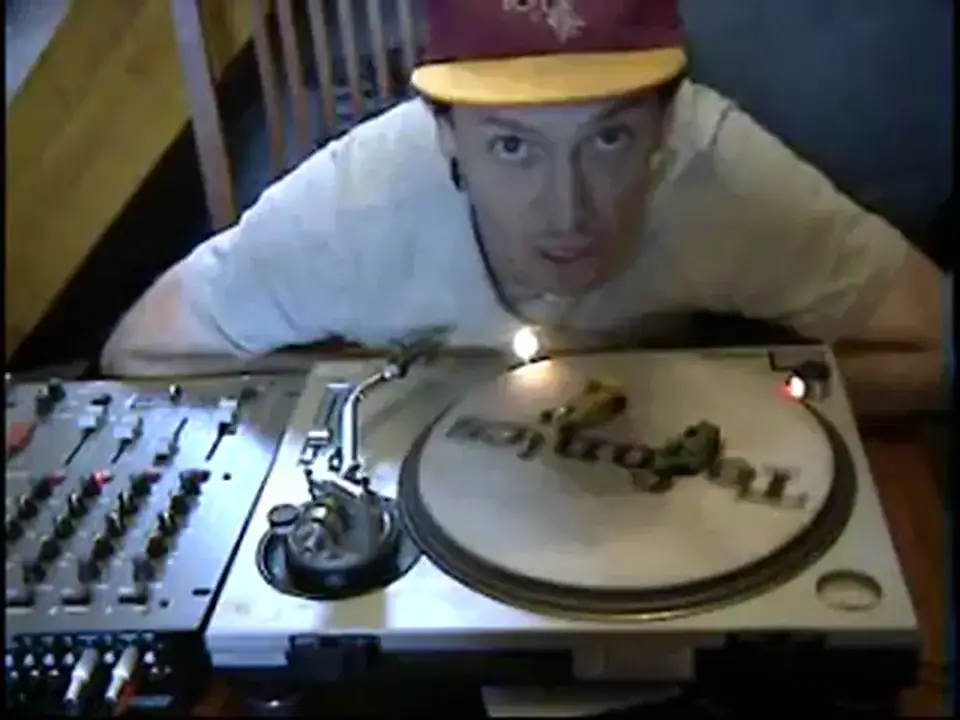
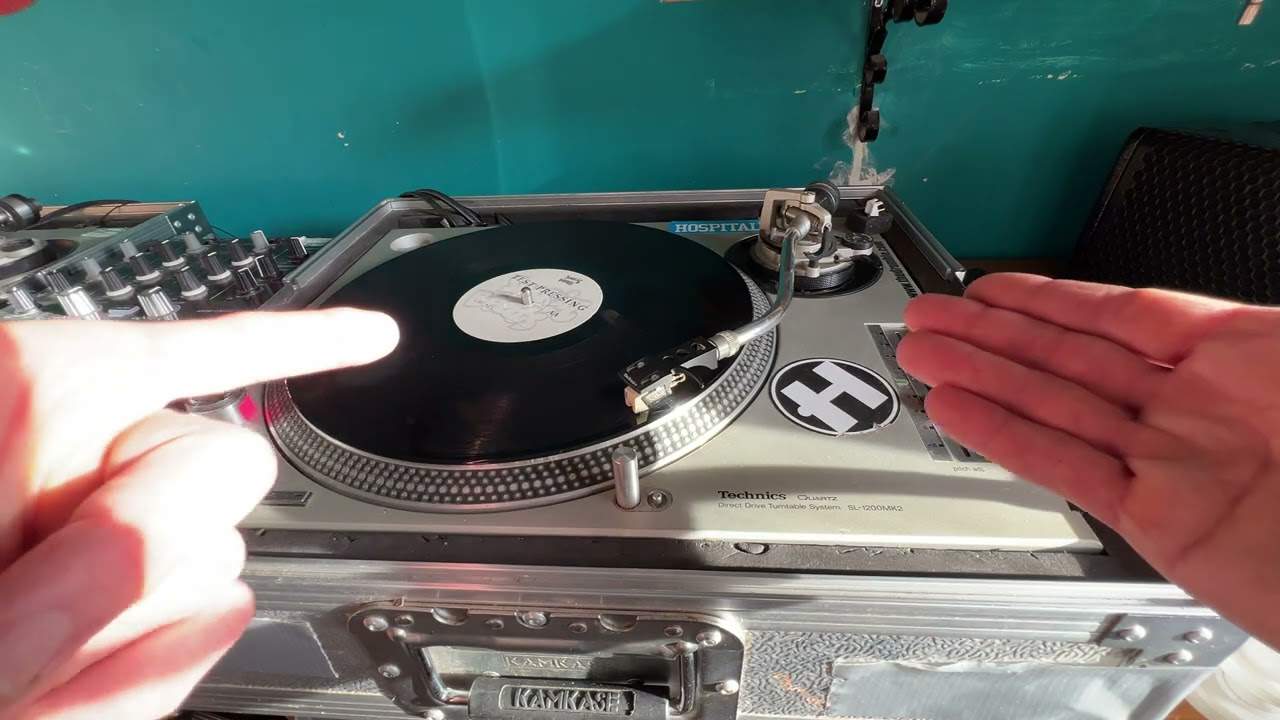
Alright folks, g'day. This is the second lesson, Idiot's Guide, Beginners. This is my, and only my interpretation. There are other interpretations, so you can take it or leave it on how to mix for a beginner, okay? Now then, you're possibly wondering why I have got two of my son's cars on the deck. I shall explain. If you... If you don't know anything about beats per minute, BPM, I suggest you go and see the first lesson because that is quite important. You need to know what BPM, beats per minute, is first. I suggest if you don't know that, watch that then come back to this one. What we're going to do, I want you to imagine that these two cars here are records. The green one, we will talk about the fact that the green one is going at 138 beats per minute or 138 miles an hour.
All this is just logic. You don't need to be a fantastic mathematician to work this out. If these two cars start off at the same time, 138, 130. Now then, after one second, which one is going to be going the fastest? Or which one... Thank you for watching. As he reaches that precise point, okay? Now, he's got to use his eyes. He's got to look to his left and see. As soon as he sees the wheels of that car directly in line with his wheels, he knows to slow down because he's exactly at the same point. That is near enough the philosophy with DJing. That's why you see a DJ headphone here listening to the sound system through this ear because this ear... He's almost acting as the same as the driver's eye would be here. He's catching up, as soon as he's caught up, he's watching, looking and slowing down. Now then, think about it. Throttle, your throttle control, okay? He's got to have good throttle control because if he puts too much throttle, he will speed up. If he doesn't do enough throttle, he'll slow down. That is why you see good DJs keeping their fingers here. That is the throttle.
2:43 That philosophy with the record
Unless, of course, he's got cruise control. In other words, flicks into cruise control because he knows it will stay precisely in the right place. Now then, I'm going to show you that philosophy with the record. And I have near enough shown you anyway that if you think about it, in one of my lessons I did sharp movements. Because what I was actually doing, I was listening through this ear. No, I didn't have headphones then. But what I was doing, I was actually listening to the two beats. After a while, quite often, well not quite often, but sometimes you don't need headphones because you can actually distinguish the beats and you're almost listening to them. They're getting closer, moving away. They're like this. This is how fine it is. If you imagine a needle point and you have to match those two needle points precisely in the same place, that is what you have to do to get a perfect mix because at the end of this styli is a very, very fine point.
When that styli hits a beat, bang, to get it precisely in the mix, that styli over there has got to hit it in exactly the same place, bang. So it's no point... Can't flip with that one. It's got to be together, OK? Now then, what we'll do, OK? This guy over here, it's Beanie Benassi Satisfaction. We know that is roughly, I do, I'm telling you, it's roughly 130 BPM. So what have I done? I've written it on my record, 130 BPM. So I know, a year from now, 10 years from now, I haven't got to think, what was it? It's there and ready for me, OK? Right, I'm going to put that one on. That one now is in the green, OK? You can't see that. That over there is in the green, so they're both there. They're both going to start at exactly the same time. Now, I know this is faster, so I know I've got to slow it down anyway. But you'll see what happens, OK? I won't just slow it.
5:16 They're getting less of a gap
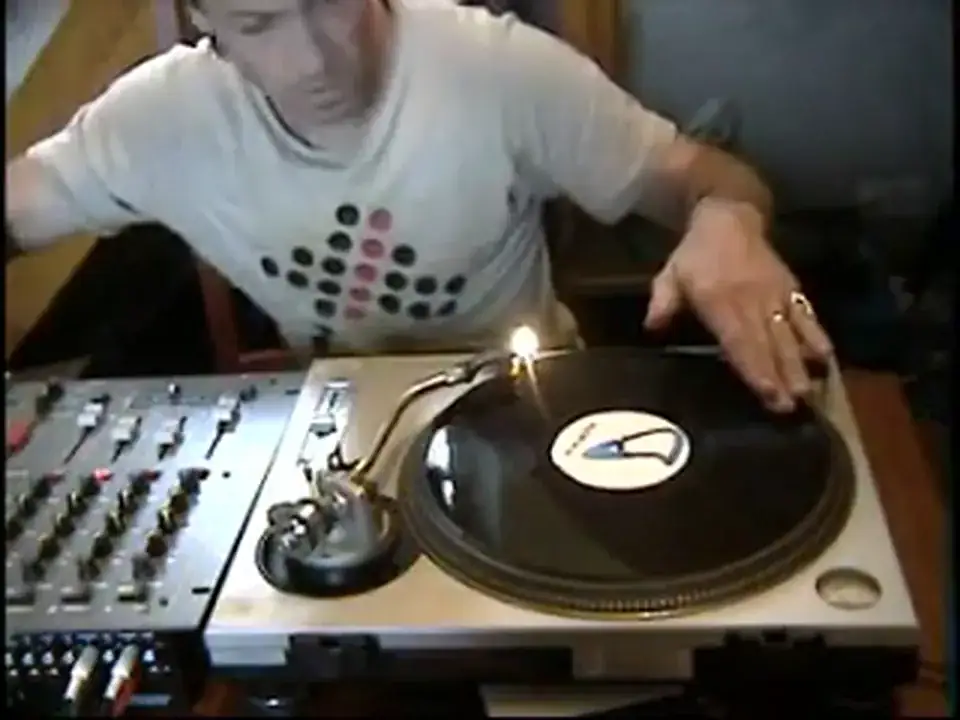
Until it gets to like, you know, 130. I've actually got to slow it down far more until it hits that bump, the beat. They're both together and then I'll bring it back up. That's why you see me doing this. I'm finding, I'm fine-tuning that beat until eventually smaller and smaller movements and there, it's there. But I never take my finger off the pitch until I'm 100% sure I've got it in, okay? Right, we'll start them off together. Okay, that's that one. Right, too fast. Beats smaller. They're getting less of a gap. Less of a gap in between the beats. Closer. Getting closer. We're there. Now I've got to fine-tune. Fine-tune. Speed up. See my speeding, I had to speed it up, not a tiny bit. If I'd have moved it a tiny bit, I'd be there all day. Bring it up, knock it back down. But again, use your eyes. You need to look where it was. Pay attention to exactly where it was. If it needs to be sped up, you look, bring it up and then put it back down a tiny bit above where it used to be. Okay, we're there. Only a tiny bit. Now, what I need you to do, I need you to...
To watch this again, okay? Now, two points. Imagine what you've got to think of is the cars, okay? If you're driving a car, what is the most important thing you've got to think about? You've got to look. You have to look, okay? With turntables and mixing, you don't have to look, okay? With a car, you're using your eyes to make sure that person, the wheels are lined up precisely. You need your eyes. With mixing, you don't really need your eyes. You need these guys here, ears. You need to listen. Quite often what does help, close your eyes, concentrate on the mix, okay? All you've got to think of here is your fingers on the pitch control. If the volumes are set correctly, you don't have to mess around with the volumes. You don't have to mess and look good with the bass, mid and treble. You do that when you get professional and you're good at it, okay? The main thing is if you want to go out, you want to do a party, you want to sound good,
Practice doing this and then you will sound good. I hope I've been a help. Take it easy.
This transcript was produced automatically from the audio of the video and may contain mistakes.